Eating Alone in Korea: What to Order and How It Works
A practical guide to solo dining in Korea: individual meals, minimum orders, kiosk and tablet ordering, payment timing and useful Korean phrases.
It's lunchtime and you're standing at a restaurant door in Seoul. Through the glass you can see steam rising from soup bowls, a row of small tables, and a kiosk screen glowing near the entrance. Someone inside looks up. You're on your own, you're hungry, and you're not sure what happens next.
Good news: this moment is usually much simpler than it feels. Here's how solo dining in Korea works, what to order, and what the menu signs actually mean.
Easy meal formats to start with
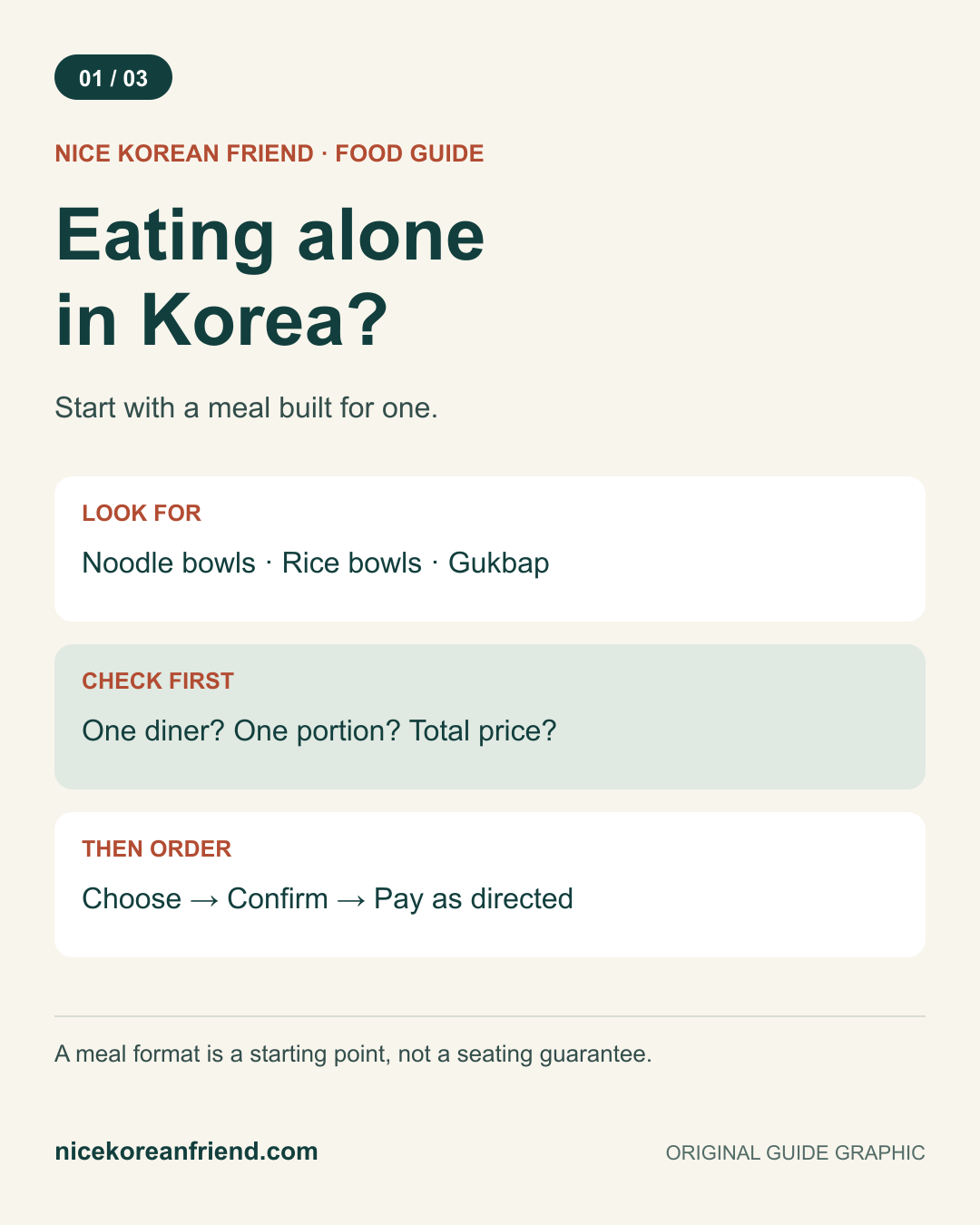
These formats commonly come as individual meals, which makes them good starting points. They are not a promise that every restaurant serving them will seat a solo guest. Each place sets its own rules.
- Noodle bowls: knife-cut kalguksu, cold naengmyeon or ramyeon, usually ordered by the bowl.
- Gukbap: rice served in or with a hot soup. Filling, quick and common at lunch.
- Bibimbap: rice topped with vegetables and usually a sauce, mixed at the table.
- Gimbap: seaweed rice rolls, easy to eat in or take away.
- Donkatsu: breaded pork cutlet, usually served as a single set with rice and soup.
1인분 is a portion, not a permission
You'll see 1인분 (il-in-bun) on many menus. It means one portion, and the price next to it is usually the price for that one portion.
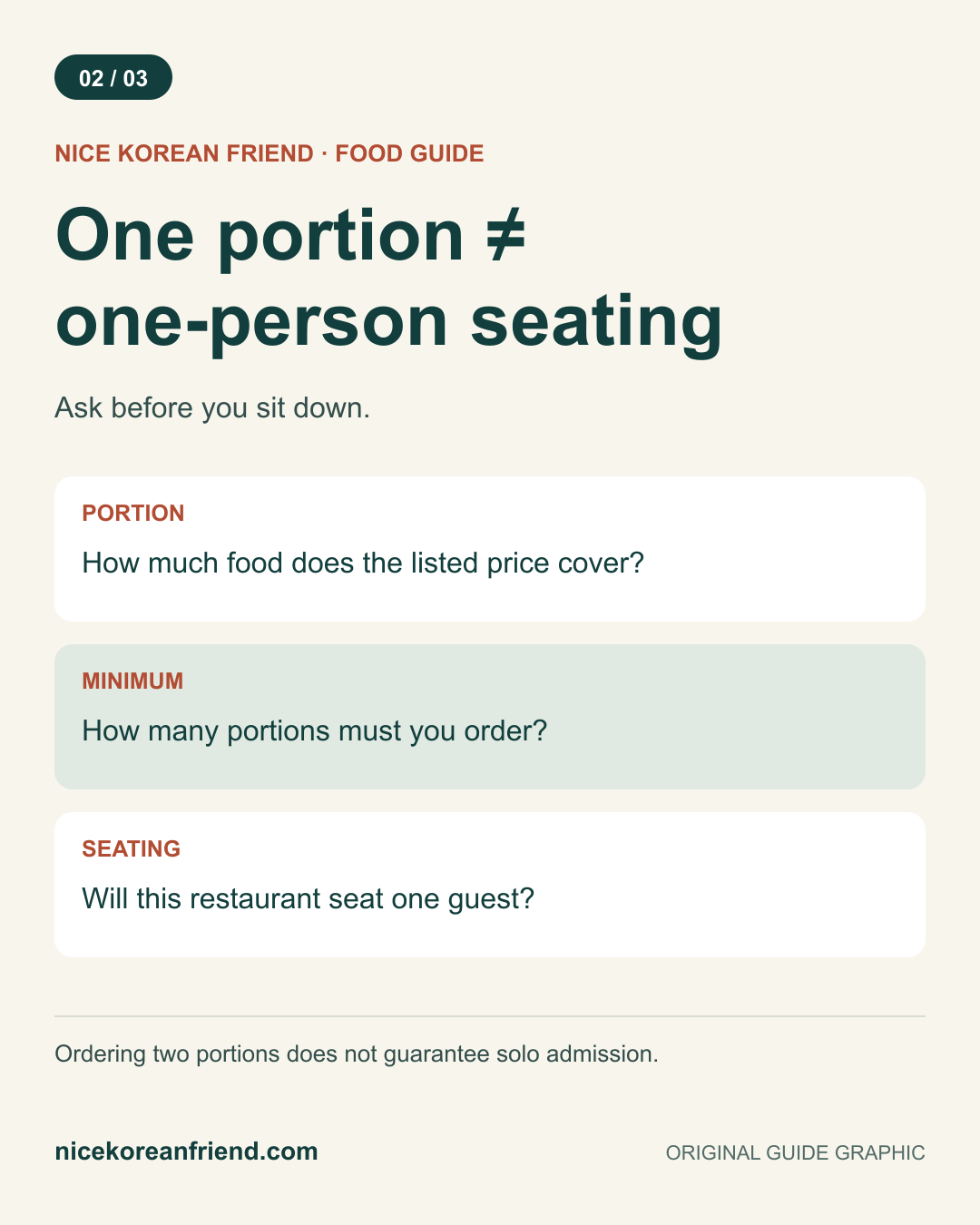
What 1인분 does not tell you is whether one person may sit down alone. A restaurant can sell food by the portion and still prefer groups at busy times. Treat it as a pricing unit, not a welcome sign.
2인분 이상 vs 2인 이상: one small character matters
These two look almost identical, but they mean different things:
- 2인분 이상 = minimum two portions. The rule is about how much you order.
- 2인 이상 = two or more people. On a seating or party-size notice, this is a condition about the number of diners. Read the full line, because menu wording can vary.
Some places will let a solo diner order two portions; others won't. Buying two portions does not guarantee you'll be seated, so ask first.
A quick menu example (invented)
This is a made-up example, not a real restaurant or price. Imagine a menu line that reads: Grilled pork, 1인분 ₩10,000 (2인분 이상).
The ₩10,000 is the price per portion. Because there's a two-portion minimum, the smallest possible order is two portions, or ₩20,000 in total, before rice, drinks or extras. The number on the menu isn't always the number on your bill.
BBQ and shared hot pots
Table-grill BBQ and big shared stews like jeongol are cooked for the whole table, so these are the dishes most likely to carry a minimum order or a group rule. Some places welcome solo diners anyway, some have dedicated solo setups, and some don't. Check the current policy with the restaurant before you sit down.
Ask before you sit
Before you take a seat, catch a staff member's eye, hold up one finger, and ask: 혼자 먹어도 돼요? (Is it okay to eat here alone?). A nod or a hand pointing toward a table means you're in. If they suggest a counter seat or another time, that's simply how that place runs during busy hours.
Ordering at a kiosk or tablet
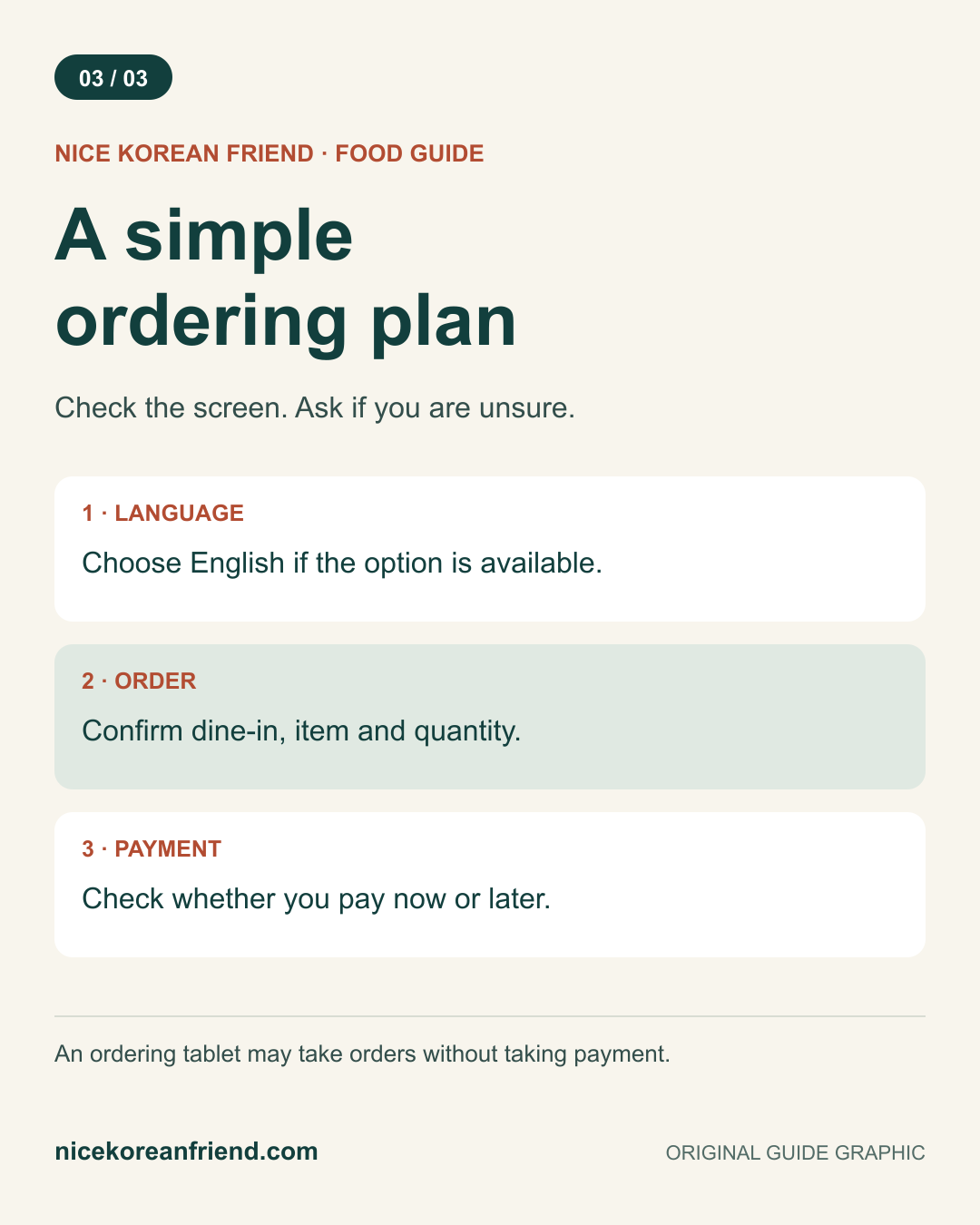
Many restaurants use ordering kiosks, and some have tablets at each table.
- Look for a language button. Some kiosks offer English or other languages; not all do.
- Choose dine-in or takeout (매장 or 포장).
- Pick your dish, set the quantity, and add it to your cart.
- Pay, if the kiosk takes payment.
Payment varies. Some kiosks take cards on the spot, while some table tablets only send your order to the kitchen and you pay at the counter later. If a screen stumps you, step aside and ask the staff; pointing at the menu works fine. It's also wise to carry a second card or some cash, since not every machine will read every foreign card.
Water, cutlery and refills
Look for a 셀프 (self-service) sign. In many restaurants you pour your own water from a dispenser, and spoons and chopsticks sit in a drawer at the table or in a holder. Side-dish refills vary: some places have a self-serve bar, some refill when you ask, and some charge for extras. There's no single rule, so follow the signs or ask.
Paying and etiquette
Follow the restaurant's payment instructions: you may pay at a kiosk or with staff before eating, or at the counter afterward. Tipping generally isn't expected in Korean restaurants; a simple 감사합니다 (thank you) on your way out is the norm.
Menu labels at a glance
| Korean | What it means |
|---|---|
| 1인분 | One portion |
| 2인분 이상 | Minimum two portions |
| 2인 이상 | Two or more people |
| 혼밥 | Eating alone |
| 매장 | Dine in |
| 포장 | Takeout |
| 셀프 | Self-service |
| 공기밥 | Bowl of rice (often ordered separately) |
Six phrases worth saving
- 혼자 먹어도 돼요? Is it okay to eat here alone?
- 1인분도 주문할 수 있어요? Can I order just one portion?
- 이거 하나 주세요. One of this, please.
- 고기 육수가 들어가요? Is there meat broth in this?
- 카드 돼요? Do you take cards?
- 계산은 어디서 해요? Where do I pay?
A note on dietary needs
A dish that looks like vegetables can still contain meat or seafood. Broths are often made from beef, pork, chicken or anchovy, and sauces and kimchi may include fish sauce or salted seafood. Ask about the broth and the sauce specifically rather than judging by appearance. If a dietary need matters a lot to you, don't rely on a guess: ask, and choose another dish if the answer is unclear.
Finding solo-friendly places
The MICHELIN Guide's Seoul restaurant directory currently offers a solo dining filter alongside bowl-based cuisine categories. It's handy for discovery, though it can't tell you how a particular restaurant is handling seating on the day you visit.
Travel guides help too. Visit Seoul's solo traveler's guide, revised in June 2026, mentions Myeongdong Kyoja as a place that can seat solo guests. The Korea Tourism Organization's listing describes kalguksu, dumplings (mandu) and bibimguksu on its menu. Treat it as one example and check current conditions before you go.
To compare places near you, see our guide to Google Maps vs Naver Map vs KakaoMap in Korea. If you'd like a sit-down meal that needs a booking, read how to make restaurant reservations in Korea without a Korean phone number.
A simple one-day plan for eating alone
- Morning: a roll of gimbap to eat in or take away.
- Lunch: gukbap or a noodle bowl. Quick, filling and single-serving.
- Afternoon: a snack from a bakery or a street stall.
- Dinner: donkatsu or bibimbap, or BBQ if you've asked first and the restaurant says yes.
Frequently asked questions
›Is it rude to eat alone in Korea?
No. Eating alone is ordinary, especially at lunch. The things to watch are minimum orders and busy-hour seating, not the act of dining solo.
›Can I go to Korean BBQ by myself?
Sometimes. Some BBQ places seat solo diners, some require two portions, and some only take groups. Ask at the door before you sit.
›What if the kiosk has no English?
Try a translation camera app, point to photos on the screen, or ask staff for help. Ask whether they can take the order or payment directly; a separate counter flow is not guaranteed.