South Korea Plug Adapter Guide: Can You Use Your Charger?
Korea uses 220V, 60Hz round-pin sockets. Learn to read your charger's INPUT label and choose the right plug adapter before you fly.
Korean voltage and socket basics
South Korea's standard household supply is 220V at 60Hz, and outlets take plugs with two round pins.
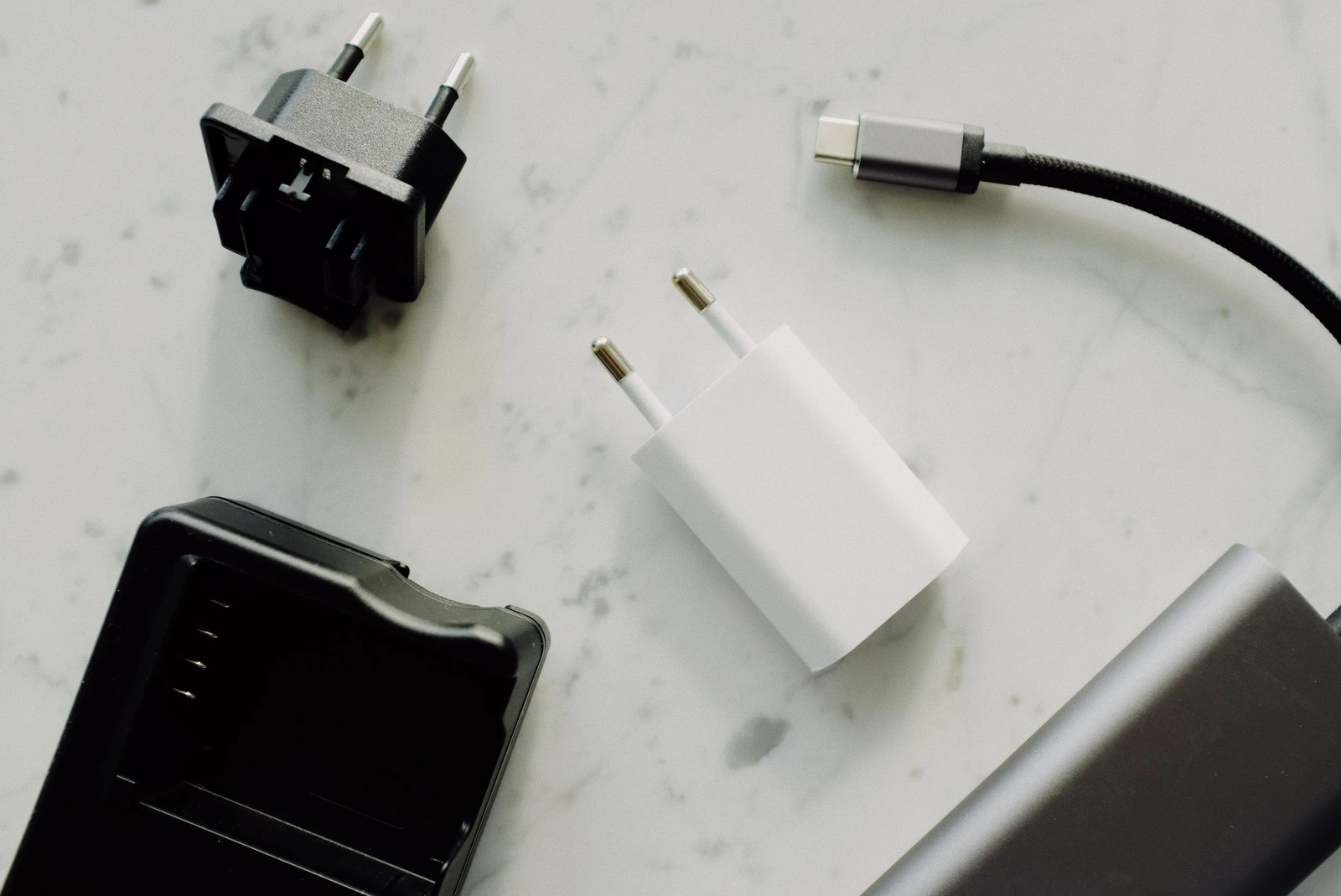
Adapter maker SBS lists two plug types on its South Korea country page: Type C, a two-round-pin plug with no earth, and Type F, a two-round-pin plug with earthing contacts on the sides.
Look for a South Korea-compatible plug adapter that meets your device's grounding and load requirements. Shape alone doesn't prove safety. A slim Type C Europlug may fit, but it does not give you an earth connection. Don't assume every European plug fits, or that every outlet you meet in Korea is identical. If a plug won't sit firmly in the socket, don't force it and don't use it with a loose fit.
Plug adapter vs voltage converter vs USB charger
These three things solve different problems.
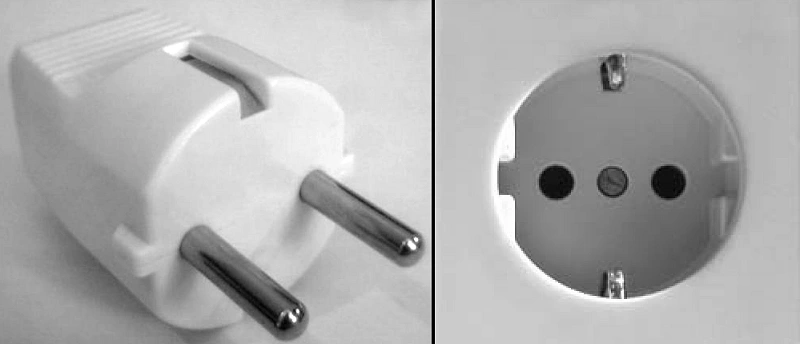
- Plug adapter: changes the plug shape so it fits the socket. Power passes straight through at local voltage, which in Korea is 220V. SKROSS says plainly in its travel adapter manual that a plug adapter is not a voltage converter, that your appliance's input must match the mains supply, and that the adapter's maximum load and safety instructions apply.
- Voltage converter: changes voltage. It is not a generic fix, especially for hot hair tools (more below).
- USB charger: the brick that turns wall power into USB power. Some adapters have USB ports built in. That USB section does its own conversion, separate from the AC socket that passes 220V through. On those adapters, total USB power may be shared across ports, so check the adapter's own specs.
One common mix-up: a USB-C cable on its own is not a charger. It needs a compatible power source, such as a wall charger, power bank or laptop port.
Read INPUT, not OUTPUT
Your charger has a small printed label. The line that matters for Korea is INPUT: what the charger accepts from the wall. The OUTPUT line is what the charger sends down the cable to your device. USB chargers may list values such as 5V, 9V or 20V; laptop bricks can also supply a device through a dedicated connector. Those numbers tell you nothing about Korean wall power.
As examples, Apple says its USB power adapters accept 100–240V AC at 50–60Hz. Samsung's Galaxy charger support information likewise lists an input range of 100–240V. These are examples, not a promise about every charger in the world. Read your own label and manual.

What does your label say?
The rows below are illustrative examples. Your manufacturer's instructions come first.
| Your label says | What it means in Korea (220V, 60Hz) |
|---|---|
| INPUT 100–240V ~ 50/60Hz | Covers Korean power. Usually no voltage conversion needed if the maker permits; a compatible plug adapter is typically enough. |
| INPUT 220–240V 50/60Hz | Covers Korean voltage and frequency. Still confirm the maker permits use with a plug adapter, stay within the adapter's load limit, and keep earth if the device requires it. Plug shape alone isn't enough. |
| INPUT 110–120V only | Do not plug it directly into 220V. Ask the manufacturer or use an approved alternative. |
| 50Hz only, or unclear | Ask the manufacturer. Don't assume a converter fixes frequency. |
| OUTPUT 5V / 9V / 20V | What the charger sends to your device, not wall-input compatibility. |
Your home plug vs Korean sockets
If your plug has flat pins (as many US and Japanese plugs do) or three rectangular pins (as UK plugs do), you need an adapter to change the plug shape, and you still need to check voltage and frequency. If your home plug already has round pins, it may fit, but round pins alone don't mean your device is rated for 220V.
Earth matters too. Two-prong chargers designed without an earth pin are not automatically unsafe. But if your device requires grounding, use an adapter path that keeps the earth connection. Never remove or bypass an earth pin, rewire a plug, or stack adapters. Check the adapter manual before connecting any power strip; the SKROSS model linked above prohibits multiplug sockets.
Phones and laptops vs hair tools
For laptops, the connector shape is not the whole story. A USB-C plug that fits doesn't mean the charger supplies enough power or the right charging protocol. Bring the charger and cable made for or approved for your laptop.
Hair dryers and straighteners need a closer look, because the exact model matters. Some tools are built for a single voltage range, some have a manual voltage switch, and some adapt automatically. For example, Dyson describes its current Supersonic Travel as adjusting automatically to 110–240V. That describes one model, not every Dyson or every dryer, so don't generalize in either direction.
Check your exact tool's input label and manual, and whether the maker approves it for use with a plug adapter. A 120V-only tool does not become compatible because its pins are round. If your tool has a manual voltage switch, set it as the maker instructs before you plug in. The simplest option is often to ask your accommodation whether a hair dryer is available, though that isn't guaranteed everywhere.
Packing, and what to do if you forget
For phones, tablets and laptops, pack these three things as needed:
- A charger whose INPUT covers 220V, 60Hz
- A South Korea-compatible plug adapter that meets your device's grounding and load requirements
- The correct USB cable for that device
Don't bring a 120V-only power strip expecting an adapter to fix it.
Forgot your adapter? Ask the hotel front desk whether they lend or sell one, or check an electronics or travel shop. Availability varies, so it's easier to pack one. Our Korea hotel check-in guide covers other things worth asking at the desk.
Arrival checklist
- Read the INPUT line before plugging anything in.
- Make sure the adapter sits firmly in the socket.
- Stay within the adapter's maximum load.
- Follow your device's and adapter's manuals.
- Once your phone is charged, set up mobile data with our Korea eSIM setup guide.
Frequently asked questions
›Do I need a voltage converter for my phone in South Korea?
Often not. Many phone chargers are rated INPUT 100–240V, 50/60Hz, which covers Korea's 220V, 60Hz supply, so a compatible plug adapter is usually enough if the manufacturer allows it. Check your own charger's INPUT label to confirm.
›Will a European plug work in Korea?
Some will fit, but not every European plug fits every Korean outlet. A Type C Europlug may fit but provides no earth connection. Look for a South Korea-compatible plug adapter that meets your device's grounding and load requirements.
›Can I use my US hair dryer in Korea?
Only if its label or manual says it supports Korea's 220V, 60Hz supply. A 120V-only dryer should not be plugged into 220V, even with an adapter. Check your exact model, follow the maker's voltage-switch instructions if it has one, or ask your accommodation whether a dryer is available.
›What does the OUTPUT number on my charger mean?
OUTPUT values such as 5V, 9V or 20V describe the power the charger sends to your device. They don't tell you whether the charger accepts Korean wall power. For that, read the INPUT line.