A Rainy Day in Seoul: 3 Indoor Plans with Less Travel
Rainy day in Seoul? Pick one indoor anchor: National Museum of Korea, Seoul Museum of History or Starfield Library at COEX, plus meal tips and Korean phrases.
Picture this: you wake up in Seoul, open the curtains, and the street below is shiny with rain. Yesterday's plan of a palace in the morning, a market at lunch and a viewpoint at sunset now means three wet transfers and soggy shoes by noon.
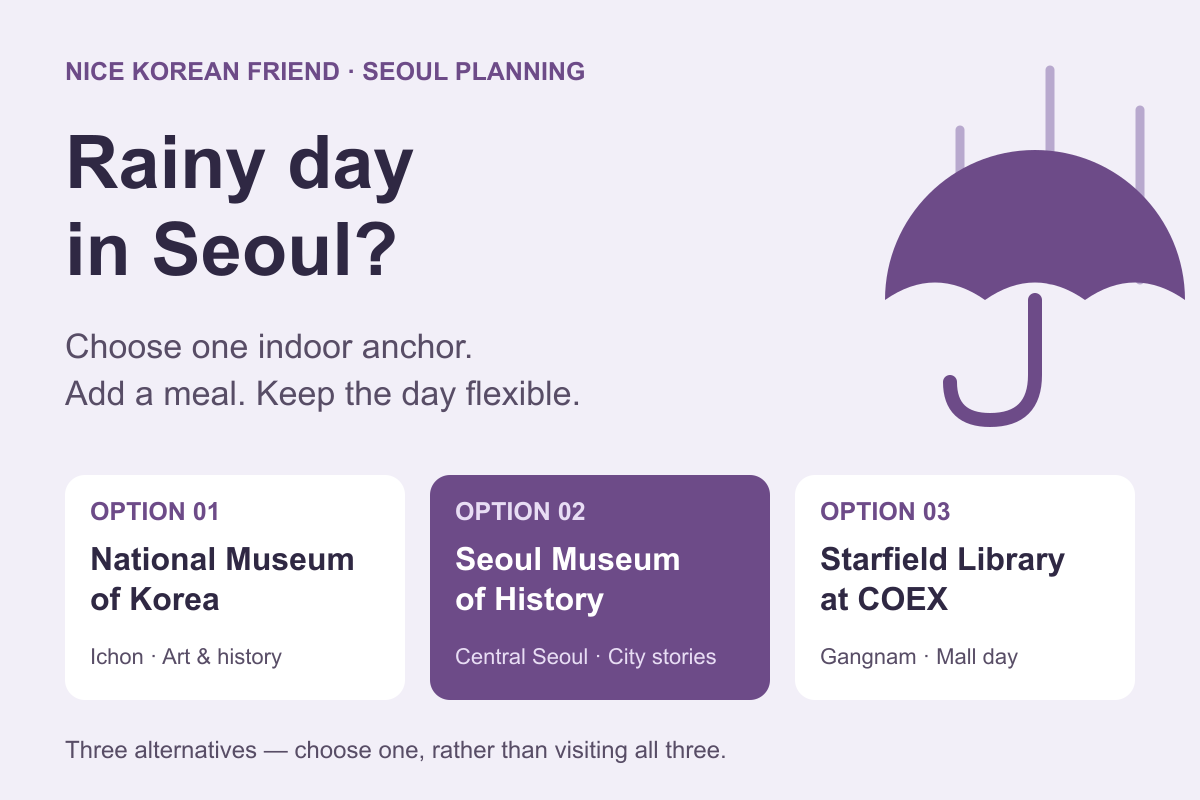
Here's the fix we'd suggest: don't rebuild a three-stop itinerary. Pick one indoor anchor near where you're staying, add one meal or coffee break nearby, and let the rest of the day stay loose. Less crossing the city means less time on wet sidewalks and fewer stairways with a dripping umbrella.
Below are three alternative plans. Choose one, not all three.
Quick decider
| Anchor | Choose it if… | Check first |
|---|---|---|
| National Museum of Korea (Ichon) | You want free permanent galleries and are happy to spend a few hours | Today isn't a closure day; whether the exhibition you want is a paid special |
| Seoul Museum of History (Gwanghwamun) | You're staying downtown and want a shorter, city-focused visit | It isn't Monday; whether an evening extension applies today |
| Starfield Library (COEX, Gangnam) | You want a flexible stop with food and shops around you | You're heading to COEX in Gangnam, not another Starfield |
Plan 1: National Museum of Korea and Ichon
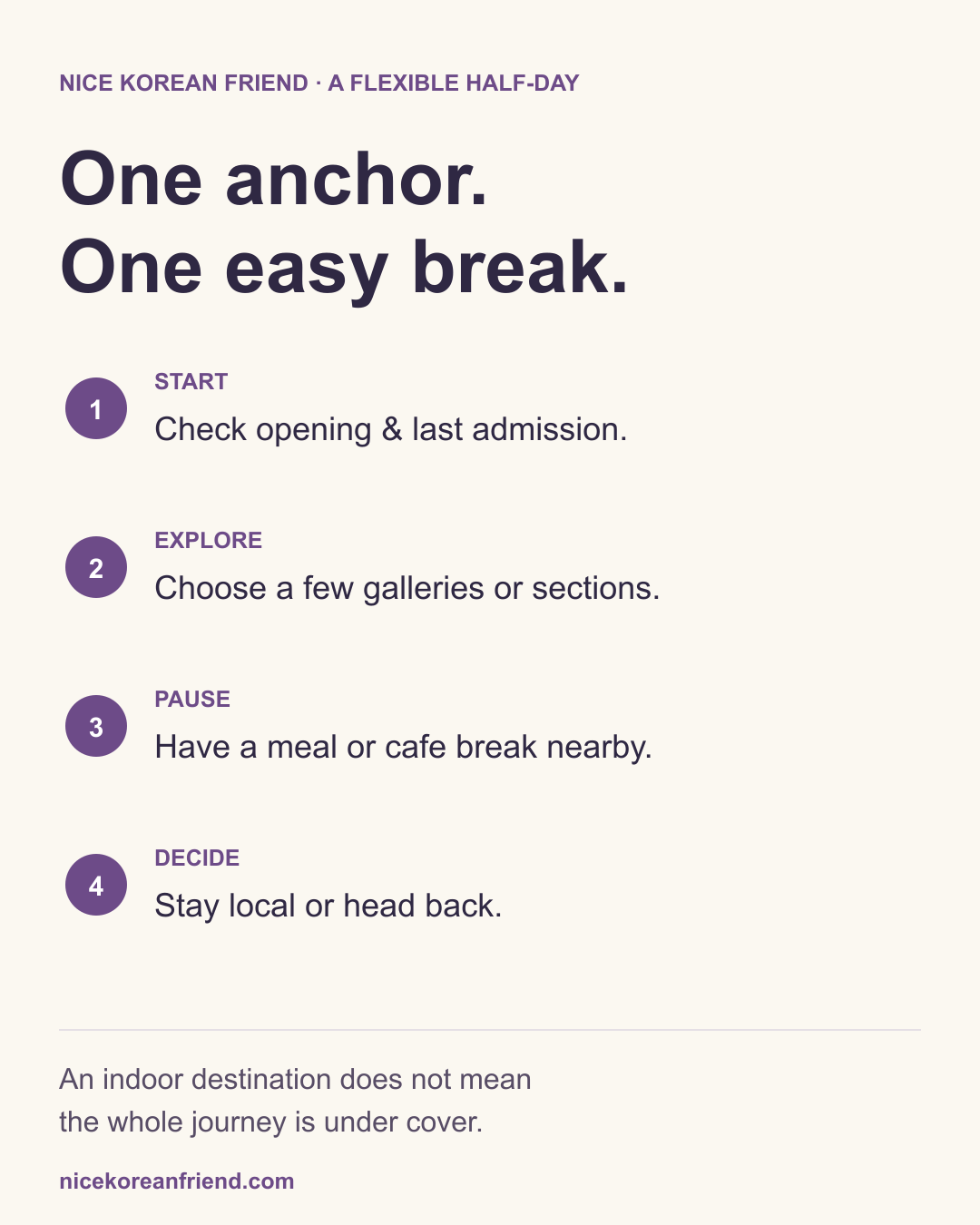
Best for: a slow museum morning or afternoon of roughly 2–4 hours. That's our editorial suggestion, not an official timing.
Getting there: Take Line 4 or the Gyeongui–Jungang Line to Ichon Station and follow signs for Exit 2. The museum's directions page describes an underground walkway toward the museum, but expect some walking outside too, and check the route against your own needs before relying on it.
The plan: The National Museum of Korea lists its permanent galleries as free, while special exhibitions may charge depending on the show. Don't try to see everything. Pick two or three galleries, perhaps one period of Korean history and one art or craft collection, and give each of them real attention. If a ticketed special exhibition catches your eye, treat it as a separate, optional add-on and check its price and entry rules on their own.
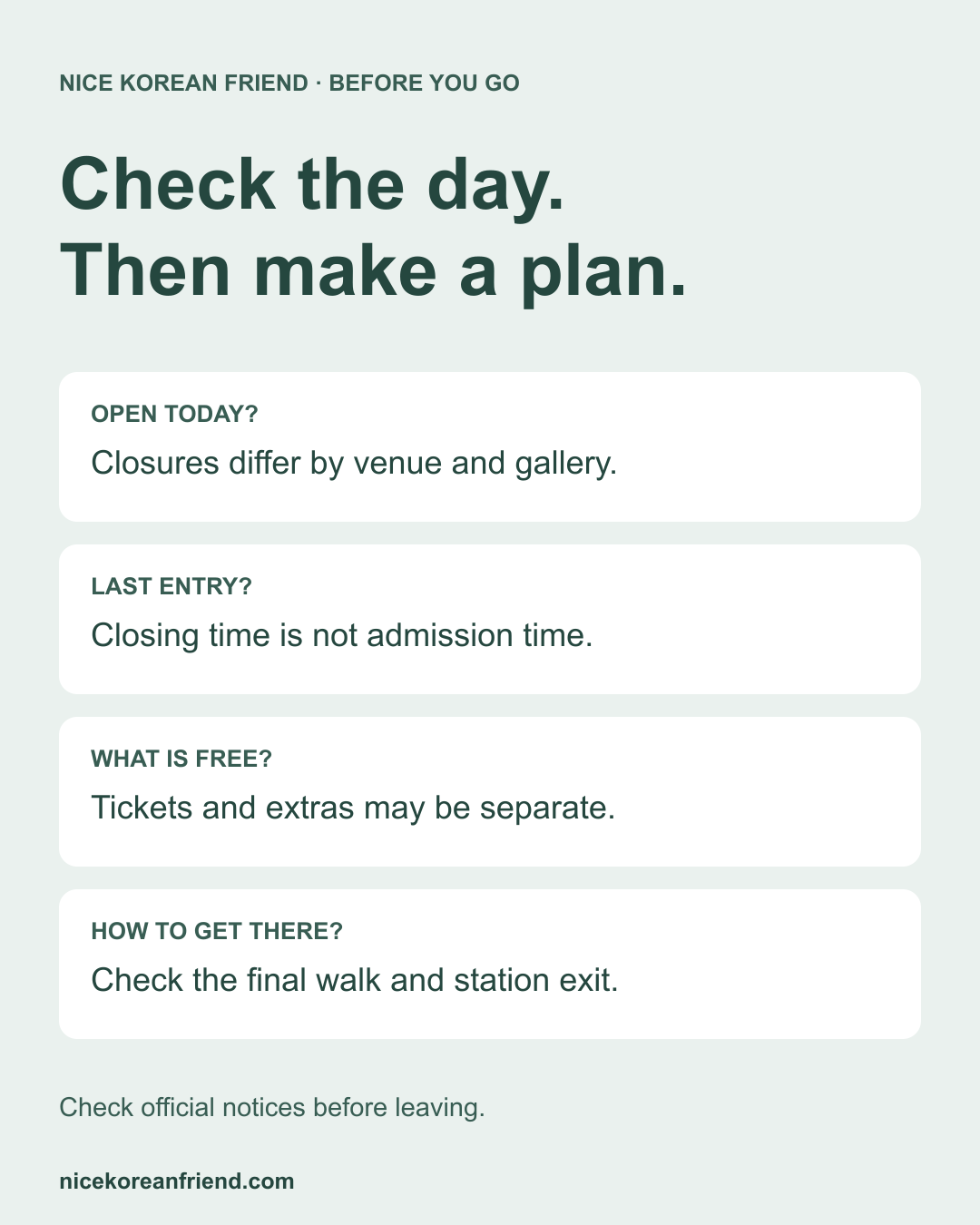
Last entry is listed as 30 minutes before closing, and the museum has a handful of holiday and gallery-specific closures during the year. Not every Monday is a closure day, but confirm today's date and any gallery closures on the official site before you leave your hotel.
Meal or coffee break: Plan a sit-down break before or after your gallery time. Check the museum's map for on-site dining, or eat near the station on your way in. Don't assume food or drinks are allowed in the galleries: eat first, then browse.
If the rain stops: Take a short walk around the museum's own grounds before heading back, rather than adding a new destination.
Plan 2: Seoul Museum of History and Gwanghwamun
Best for: a compact city-history visit if you're staying in central Seoul. Think 2–3 flexible hours.
Getting there: The Seoul Museum of History is at 55 Saemunan-ro, Jongno-gu. Its subway directions point to Gwanghwamun Station (Line 5) Exits 6, 7 or 8, or Seodaemun Station (Line 5) Exit 4. Either way, the last stretch is an outdoor walk, so allow for wet pavements on the final approach.
The plan: This museum is about Seoul itself: how the city grew and changed over time. Admission is listed as free, with standard hours of 9:00–18:00 and last entry at 17:30. It's closed on Mondays and on January 1. A Friday evening extension is currently listed, but double-check before planning a late visit.
One common mix-up: the Seoul Museum of History and the National Museum of Korea are separate institutions with separate schedules. A Monday closure here doesn't tell you anything about the national museum, and vice versa.
Meal or coffee break: The Gwanghwamun area is an office district with plenty of lunch spots and cafés. Traveling solo? Our guide to eating alone in Korea can help you pick a counter seat or set menu without fuss.
If the rain stops: Walk back to Gwanghwamun Station above ground at an easy pace instead of hurrying.
Plan 3: Starfield Library at COEX, Gangnam
Best for: a flexible, low-pressure stop of 2–4 hours where you can browse, eat and shop under one roof.
Getting there: Make sure you're going to Starfield COEX Mall in Gangnam, not a Starfield in another city such as Suwon. Choose your line based on your route: according to the mall's directions page, Samseong Station (Line 2) Exits 5 and 6 connect through Millennium Plaza, and Bongeunsa Station (Line 9) Exit 7 connects through ASEM Plaza. Those indoor links cover the station-to-mall part, not your whole trip from the hotel.
The plan: Starfield Library is a free, open public space with huge bookshelves inside a working shopping mall; the operator currently lists hours of 10:30–22:00. Treat it as a lively atrium rather than a quiet reading room: it can be busy, and seats aren't guaranteed. Wander the shelves, take a few photos for yourself, then explore the mall at your own pace. Food, drinks and shops are individually priced, so the library is free but the rest of the visit can add up.
Meal or coffee break: Choose a food court or café inside the mall so you don't need to step back outside.
If the rain stops: Leave through an above-ground exit and take a short stroll around the block before heading to the station.
What to bring and keep in mind
- A compact umbrella and spare socks. An indoor anchor cuts your time in the rain, but it doesn't make the whole day dry. A covered passage is only one part of the route.
- Wet umbrellas: use umbrella bags or stands if a venue provides them, and try not to drip across gallery floors.
- A backup meal plan. Lunch rushes happen on rainy days too.
- Big bags: if you're carrying luggage, store it before you arrive. See our Seoul luggage storage guide.
- Paid extras are optional. Free entry is the base plan; special exhibitions and shopping are bonuses.
- Check last entry and your route back before you settle in.
For routes, our Seoul subway guide covers the basics, and our comparison of Google Maps, Naver Map and KakaoMap explains which app tends to work best for walking directions in Korea.
Useful Korean phrases
| Korean | Pronunciation | English |
|---|---|---|
| 오늘 문 열었나요? | Oneul mun yeoreonnayo? | Are you open today? |
| 입장 마감이 몇 시예요? | Ipjang magami myeot siyeyo? | What time is last entry? |
| 이 전시는 무료인가요? | I jeonsineun muryoingayo? | Is this exhibition free? |
| 우산은 어디에 두면 돼요? | Usaneun eodie dumyeon dwaeyo? | Where should I leave my umbrella? |
Keep the day simple
On a rainy day in Seoul, don't fight the weather with a cross-city plan. Choose one anchor close to where you're staying, add one good meal or coffee break, and let that be enough. A slower day indoors can turn out to be one of the best parts of the trip.
Frequently asked questions
›Is the National Museum of Korea closed on Mondays?
Not every Monday. The museum has a few holiday and gallery-specific closures during the year, so check today's date on its official visitor page before you go. Don't confuse it with the Seoul Museum of History, which is closed on Mondays.
›Is Starfield Library quiet and free?
It's a free, open public space, but it sits inside a busy working shopping mall, so expect a lively atmosphere rather than a quiet reading room. Seats aren't guaranteed, and food, drinks and shops nearby are individually priced.
›Can I stay completely dry on these plans?
Not guaranteed. Indoor anchors and station connections reduce your time outside, but parts of each route, especially the walk to the Seoul Museum of History, are outdoors. Bring an umbrella and spare socks, and check your route before leaving.