Riding the Seoul Subway Like a Local
How Seoul's subway actually works for visitors: fares, exit numbers, transfers, etiquette, and the small habits that make you look local.
The Seoul subway carries millions of people a day, runs on time, has spotless stations, heated seats in winter, phone signal everywhere — and full English signage. It is genuinely hard to get lost. But there's a difference between surviving it and riding it like you live here. This is the second one.
The short version
Get a T-money card, tap in, follow the color of your line, and learn to love exit numbers. That's 90% of it. The rest is etiquette and a few local habits.
How it actually works
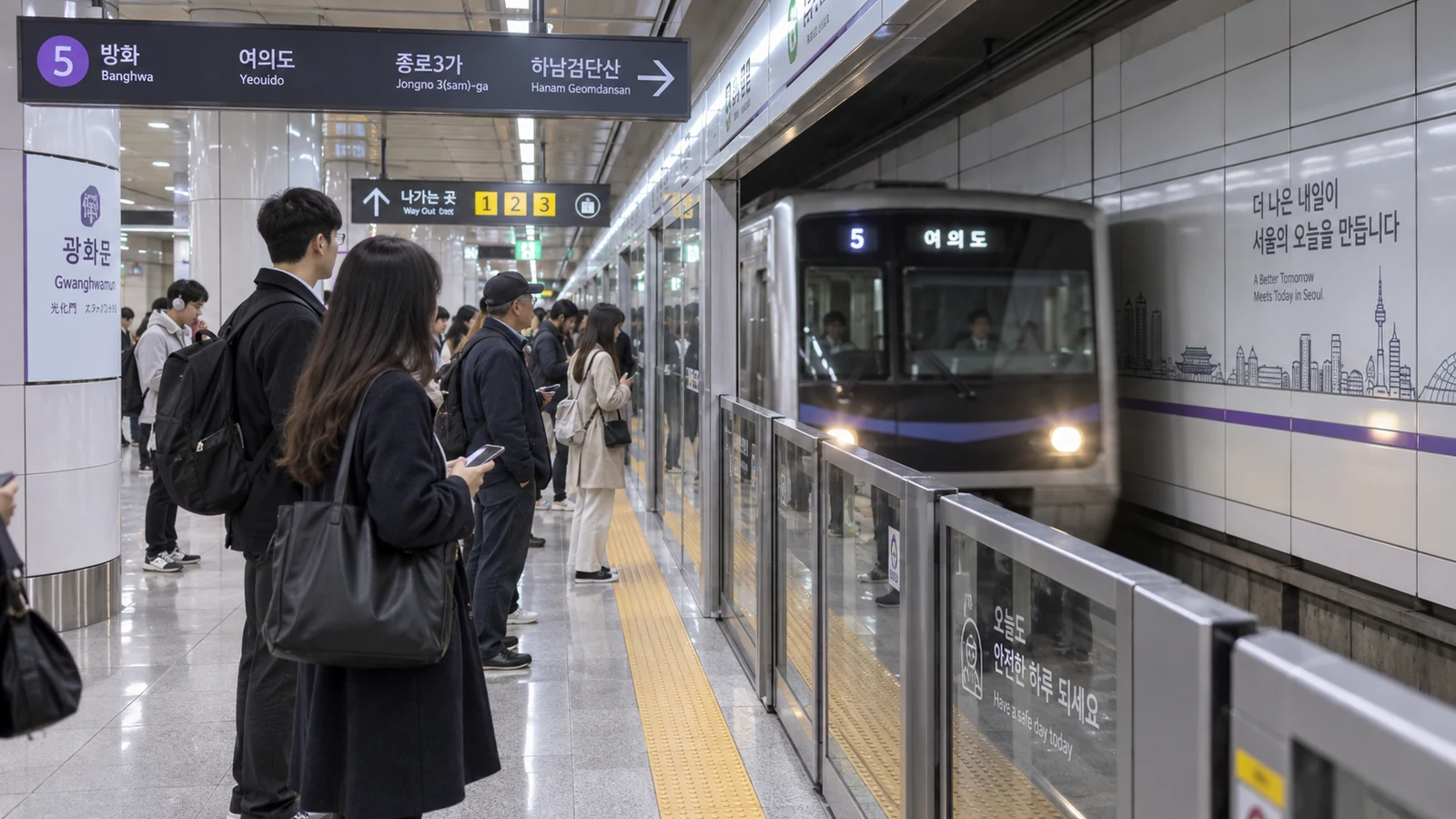
Lines are numbered and color-coded. Line 2 (green) is the circle line that reaches many major neighborhoods. Platform signs show the line and stations in each direction. On branches and circular routes, confirm the next station in your app instead of relying only on an end-of-line name.
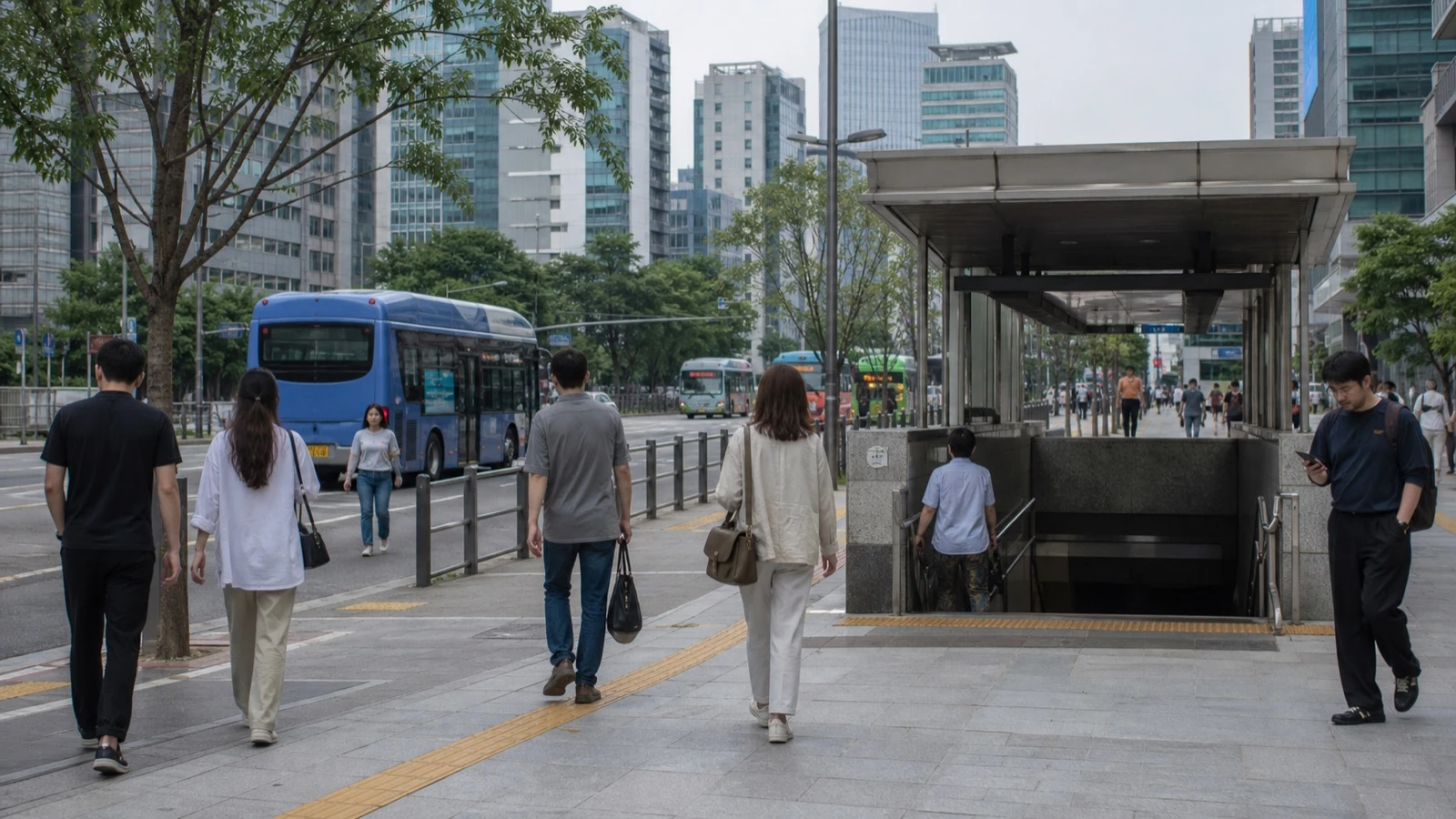
Every exit has a number, and Koreans navigate by them. When a cafe says "Hongik Univ. Station, Exit 9," that's a precise instruction: leave through Exit 9 and the directions start from there. Naver Map tells you which exit to use for any destination — trust it, because big stations can have a dozen exits hundreds of meters apart.
Transfers are corridors, not new tickets. Changing lines happens inside the gates: follow the colored signs for your next line through the transfer passage. Some transfers are long walks; that's normal. Your fare continues — no re-tapping inside the paid area.
Tap out matters. Fares are distance-based on top of the ₩1,550 base (with a transit card, as of 2026), calculated when you exit. The gate screen shows what you paid and your remaining balance.
What it costs
- Base fare ₩1,550 with T-money, ₩1,650 as a single-ride ticket — plus small distance surcharges on longer trips.
- Transfers between subway lines are free inside the gates; bus↔subway transfers within 30 minutes are discounted rather than charged as a new trip.
- Seoul's Climate Card also has visitor-friendly 1-, 2-, 3-, 5- and 7-day passes. As of September 2026 they cost ₩5,000, ₩8,000, ₩10,000, ₩15,000 and ₩20,000 respectively, plus ₩3,000 for a physical card. Compare the included service area with your itinerary; some rail sections and services are excluded.
Common misconceptions
- "I need the paper subway map." The network is huge; the map is a beautiful bowl of spaghetti. Use the app — Naver Map or Kakao Metro plans routes, picks the fastest transfer, and shows real-time arrivals and the best car to board for a quick transfer.
- "Rush hour is like Tokyo." It's crowded (7:30–9 a.m., 6–7:30 p.m., and Line 2/9 especially) but there are no pushers, and off-peak trains are comfortable.
- "Priority seats are fine if they're empty." The seats at car ends marked for elderly/pregnant/disabled passengers are left empty by many locals even in packed trains. As a visitor, the safe move is: don't sit there.
What locals do
- Follow station signs and current escalator guidance; do not block passengers or rush through a crowd to make a train.
- Line up at the floor markings beside the doors and let people off first — this one is taken seriously.
- Keep phone calls short and quiet; the subway is surprisingly hushed. Eating a meal on board is a no; a discreet sip of coffee is tolerated on the subway (buses are stricter).
- Grab a bakery snack after exiting instead — every major station is attached to an underground mall.
Good to know
- Station names are announced in Korean, English, and often Japanese and Chinese. Transfer stations get a distinctive jingle — you'll learn to react to it.
- Toilets are clean, free and inside or just outside the gates at nearly every station.
- Phone reception and 4G/5G work in tunnels, so you can navigate mid-ride.
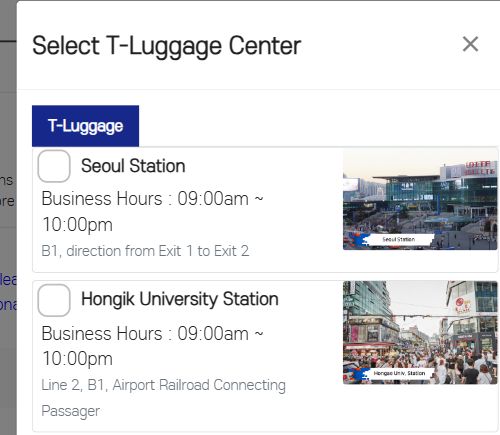
- Luggage lockers and staffed storage counters can help before hotel check-in or after checkout. Compare bag size, pickup time and the exact location before arriving.
- Heading in from the airport instead? See Incheon to Seoul transport options.
Check the fare and transfer before you travel
The Seoul subway fare table lists the adult card base fare at KRW 1,550 and the single-journey fare at KRW 1,650, before distance supplements. For an eligible bus transfer, Seoul's rules require tapping out and changing within the permitted window. Save your destination and exit number, check the final train in your route app, and ask station staff if the reader rejects your card. These checks are more useful than assuming every city, airport service or premium line uses the same fare.
Frequently asked questions
›Do I need to buy tickets for each ride?
No. A T-money card is usually simplest because you tap in and out and can receive eligible bus-subway transfer discounts. A single-journey ticket costs ₩100 more than the adult transit-card base fare and uses a refundable ₩500 deposit; international-card payment is available at newer machines on Seoul Metro Lines 1–8, but availability can vary by station.
›How late does the subway run?
Roughly from around 5:30 a.m. to around midnight, with the last trains on some lines leaving the terminus earlier. If you're out past midnight, plan for a taxi or a night bus — check the last-train time for your line in the Naver Map or Kakao Metro app rather than guessing.
›Is the subway safe at night?
Yes — Seoul's subway is well-lit, heavily used and monitored, and solo riders including women commonly ride late in the evening. Normal city awareness applies, but the last train home is a very ordinary thing to take in Seoul.
Sources and updates
Last edited on October 15, 2026. Sources support the specific details discussed in the guide; check the provider for current prices, availability and eligibility.