KTX vs Express Bus: Choosing How to Cross Korea
Compare high-speed train and express bus by total travel time, station access, current fare and luggage needs before booking an intercity trip.

The best choice depends on your destination and the departures you can actually book. Start with the complete route rather than a fixed Seoul–Busan fare table.
Compare like for like
Open KORAIL's reservation service and the KOBUS express-bus booking site for your date. Not every coach route is an express-bus service; confirm the appropriate operator for intercity destinations outside that network.
| Question | Train | Coach |
|---|---|---|
| Where do I board? | Exact departure railway station | Exact bus terminal and boarding area |
| Where do I arrive? | Destination railway station | Destination terminal or listed stop |
| What will I pay? | Current quote for train and class | Current quote for service and class |
| How long will it take? | Listed journey plus station connections | Listed journey plus terminal connections and possible traffic |
| What must I reserve? | Available ticket and seat product | Available departure and seat class |
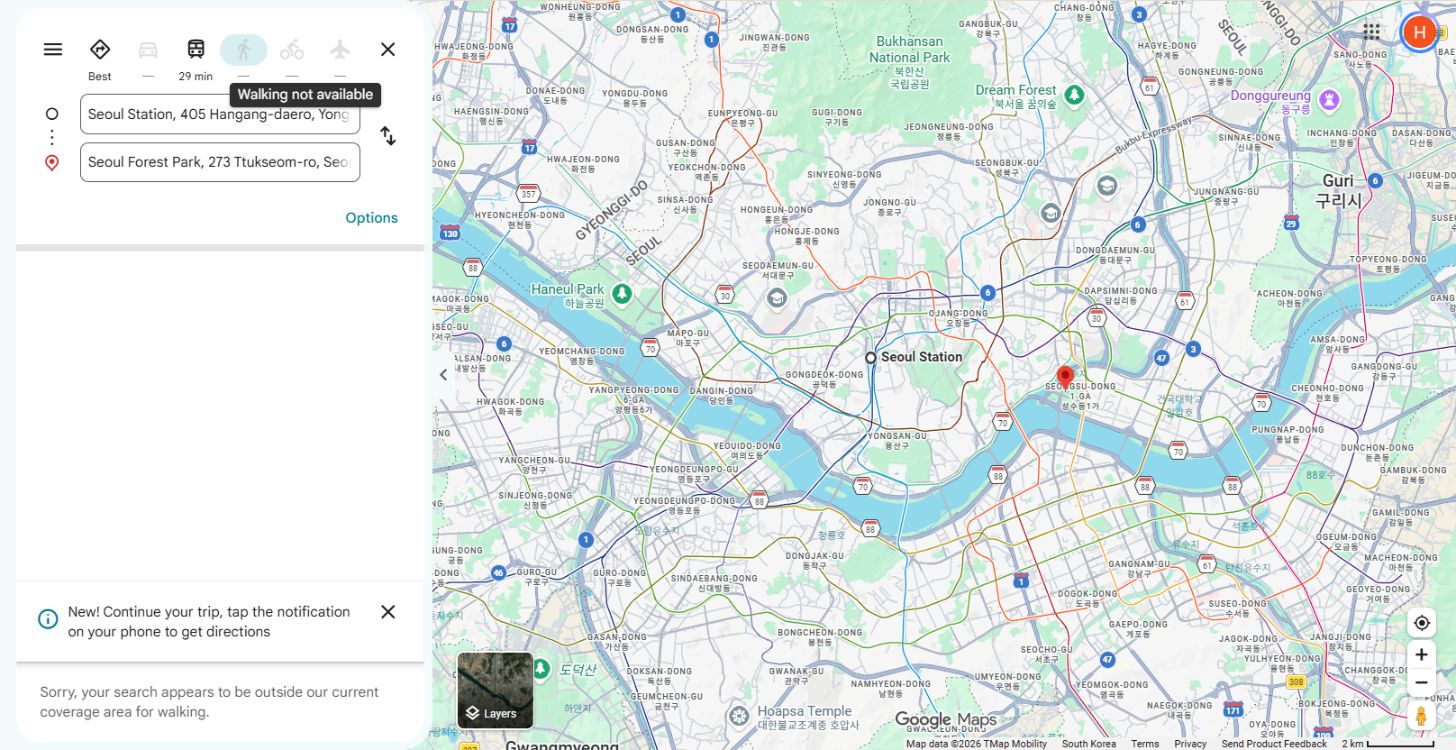
Seoul Station, Yongsan and Suseo are different locations. Seoul also has multiple bus terminals. A cheap ticket can lose its advantage if reaching the terminal adds a costly taxi ride or a difficult luggage transfer.

When a train is a useful choice
Consider a train when your destination is served by a convenient railway station and the scheduled arrival saves useful time. Check the specific train's stops and class. Do not assume every train has the same journey time, amenities or ticket conditions.
For an onward appointment or connection, leave a buffer between the scheduled arrival and your next commitment. See our train booking checklist before paying.
When a coach is a useful choice
Check a coach when its arrival terminal is closer to your destination, there is no convenient railway route, or its quoted fare fits your budget better. Compare the available seat classes on that exact service. A premium seat may cost enough to change the train-versus-bus calculation.
Road traffic can change the arrival time. Ask about scheduled rest stops if you need one, and confirm luggage or accessibility arrangements with the operator. Avoid choosing an unfamiliar overnight arrival solely because the ticket is cheap.
Make the decision with a four-line plan
For each option, write down accommodation-to-departure travel, the ticketed journey, arrival-to-destination travel, and total cost. Include local fares and any paid transfer. Then ask which route you can manage comfortably with your luggage.
For example, a train with a shorter scheduled trip may still require a long final transfer. Conversely, a coach that drops you near your accommodation may be convenient even with a longer highway journey. These are planning examples, not reports of trips we have taken.
Before paying
Confirm the terminal or station, date, passenger details, departure time, fare and cancellation deadline. Save the boarding ticket and instructions. Both networks can sell out around holidays; reserve an available service rather than counting on extra departures.
Use a T-money card for eligible local connections and a current route planner to reach the correct departure point. Check operator notices for your ticket product rather than assuming a merger announcement automatically changes all fares.
Frequently asked questions
›Is the bus always cheaper than KTX?
Compare the actual ticket quotes, including class and local connections. Avoid a fixed saving percentage: the route, seat class and available products affect the difference.
›Which journey time should I compare?
Compare door-to-door time: reaching the departure point, the scheduled trip, and the final connection. Bus arrival times can also be affected by road traffic.
›Can the bus be my backup on a holiday?
It can be an alternative, but buses also sell out. Check and reserve an available departure instead of relying on extra services or walk-up availability.
Sources and updates
Last edited on October 12, 2026. Sources support the specific details discussed in the guide; check the provider for current prices, availability and eligibility.