Food Delivery in Korea: Can Foreigners Use Baemin?
Yes — Baemin, Coupang Eats, and Yogiyo all work for foreigners in 2025–2026. Here's which handles English and overseas cards best, plus fees and minimums.
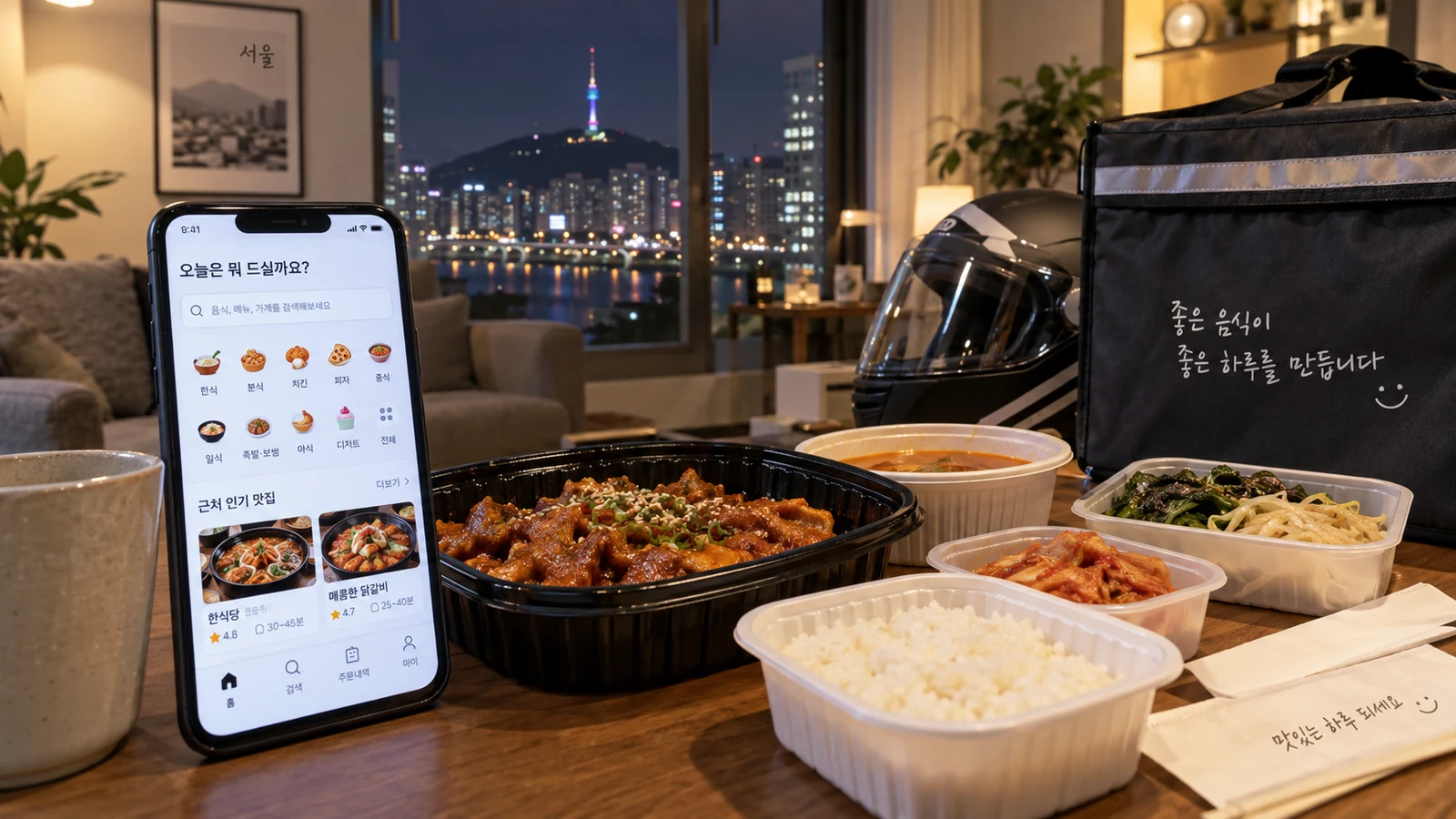
Short answer: yes, foreigners can order delivery in Korea, and it's genuinely one of the best delivery ecosystems on the planet — fast, cheap, and it'll bring a single bowl of soup to your door at 2am. The catch used to be that the apps assumed a Korean phone number and a Korean card. That's largely fixed now. Here's how the three big apps actually behave for someone who just landed.
The short version
There are three players: 배달의민족 (Baedal-ui-minjok — "Baemin"), 쿠팡이츠 (Coupang Eats), and 요기요 (Yogiyo). For a foreigner, Baemin is the default pick: it has a proper in-app English mode, doesn't demand a Korean phone number, and takes overseas cards. Coupang Eats is a strong second with an English interface and tends to be quick. Yogiyo is the most Korean-only of the three and the hardest to use without help. All three let you find your address by map pin, so you never have to type Hangul.

How it actually works
The flow is the same across apps: set your delivery location, browse nearby restaurants, add items to a cart, pay in-app, and track the rider on a live map. A few things worth knowing:
- Language. Baemin's app supports English, Japanese, and Chinese in its settings. Coupang Eats offers an English interface. Yogiyo is mostly Korean — the workaround is opening the Yogiyo website in Chrome and letting Google Translate render the menus, then ordering there.
- Sign-up. Baemin notably does not require a Korean phone number, which is the wall that stops a lot of newcomers on other services. You can register with an email and get going.
- Address. Search or drop a pin. If you're in a hotel or Airbnb, pin the building and add the room number in the delivery-notes field (a translation app helps for the note).
- Menus. Even in English mode, individual restaurant menus are often still in Korean, since they're entered by the shops. Photos help; so does our guide to Korean dishes for beginners.
What it costs
Delivery pricing has three parts — the food, a minimum order, and a delivery fee:
- Minimum order: usually ₩12,000–15,000 per restaurant. Below that, you can't check out.
- Delivery fee: ₩0–5,000, driven mostly by distance and the restaurant's own policy. It's shown before you pay.
- Single-portion exception: ordering for one used to mean padding your cart to hit the minimum. Now Baemin's 한그릇 (han-geureut — "one bowl") category has no minimum, and Coupang Eats launched a comparable no-minimum single-serving option in August 2025. Great for solo travelers.
Payment: overseas Visa/Mastercard work on Baemin, which also added Apple Pay with overseas cards in 2025. Coupang Eats accepts foreign cards as well, though whether a given card sails through can depend on your issuer. If a card is refused, having a backup card — or a Korean bank card once you're set up — solves it.
Common misconceptions
- "You need an Alien Registration Card (ARC)." You don't. A passport-holding tourist can order; the barrier was always the phone number and card, not residency.
- "You must read Korean." English mode plus map-pin addressing gets you most of the way. Photos and a translation app cover the rest.
- "Delivery only comes to houses." Hotels, guesthouses, offices, and even some parks work — just pin the location and leave a clear note.
- "It's expensive." Between low minimums, frequent free-delivery promos, and no tipping, a solo meal often lands cheaper than a sit-down restaurant.
What locals do
Koreans treat delivery as everyday infrastructure, not a splurge. A few habits worth stealing: they compare the same restaurant across apps, because fees and promos differ; they lean on Baemin for selection and Coupang Eats for speed; and they order single-portion items without a second thought thanks to the no-minimum categories. Many also keep the app's map note pre-filled with door codes and "leave at the door" instructions. And nobody tips — the price in the app is the price you pay.
Good to know
If you'd rather not fight an app at all on night one, remember a 24-hour convenience store does hot meals for under ₩10,000 — see our convenience store guide. When you do want to eat out instead of in, our walkthrough on how to order at a Korean restaurant covers the call bell, the banchan, and paying at the counter. And if a card keeps bouncing in-app, it's worth reading cash vs card in Korea before you assume the app is broken — it's usually the card, not the app.
Frequently asked questions
›Can I use Baemin with a foreign credit card and no Korean phone number?
Yes. Baemin (배달의민족) does not require a Korean phone number and accepts foreign Visa/Mastercard. As of 2025 it also supports Apple Pay with overseas cards. Coupang Eats works with foreign cards too, though success can vary by card issuer.
›Which Korean delivery app is best in English?
Baemin has the most complete in-app English mode (plus Japanese and Chinese), and Coupang Eats offers an English interface as well. Yogiyo is mostly Korean — usable via the website with Chrome's Google Translate, but it's the least foreigner-friendly of the three.
›What are the minimum order and delivery fees?
Most restaurants set a ₩12,000–15,000 minimum, with delivery fees of ₩0–5,000 depending on distance. Single-portion categories skip the minimum: Baemin's 한그릇 (han-geureut) has none, and Coupang Eats added a no-minimum single-serving option in August 2025.
›How do I enter my address if I can't type Korean?
All three apps let you search your address or drop a pin on the map, so you don't need to type Hangul. Set your delivery location before browsing — restaurant availability depends on how far you are from each kitchen.
Sources and updates
Last edited on September 4, 2026. Sources support the specific details discussed in the guide; check the provider for current prices, availability and eligibility.